
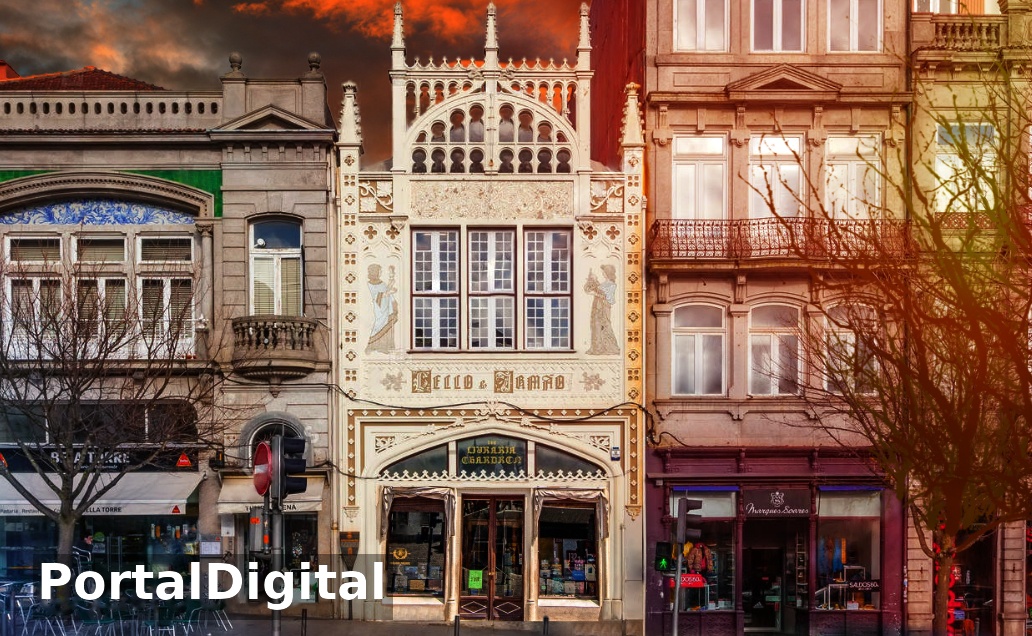
Livraria Lello is located on Rua das Carmelitas, in the city of Porto, northern Portugal.
The History of Livraria Lello in Porto
The origins of Livraria Lello date back to 1881, when the brothers José and António Lello opened an establishment in Porto dedicated to the trade and publishing of books.
José Lello was a man of culture, a reading enthusiast, a lover of books and music, he dreamed of being a bookseller and that came true in 1881 and several years later his brother António Lello also entered this business as a bookseller.
At this time, the Lello brothers moved the business to Rua do Almada without knowing that the building that would bear their name until the next millennium was just a few blocks away.
In 1894, José Lello purchased Livraria Chardron with all of its exclusive archive, such as the first editions of iconic works such as those by Eça de Queirós or Camilo Castelo Branco.
On January 13, 1906, the Livraria Lello building as we know it today was inaugurated, shaped by the magnificent vision of engineer Francisco Xavier Esteves.
The inauguration takes place in an environment full of important political figures, artists, respected bourgeoisie and merchants of the city, among whom stand out the writer Guerra Junqueiro, the director of O Comércio Bento Carqueja, the writer Júlio Brandão and Aurélio Paz dos Reis, the pioneer of cinema in Portugal.
José Lello was a man of culture, a reading enthusiast, a lover of books and music, he dreamed of being a bookseller and that came true in 1881 and several years later his brother António Lello also entered this business as a bookseller.
At this time, the Lello brothers moved the business to Rua do Almada without knowing that the building that would bear their name until the next millennium was just a few blocks away.
In 1894, José Lello purchased Livraria Chardron with all of its exclusive archive, such as the first editions of iconic works such as those by Eça de Queirós or Camilo Castelo Branco.
On January 13, 1906, the Livraria Lello building as we know it today was inaugurated, shaped by the magnificent vision of engineer Francisco Xavier Esteves.
The inauguration takes place in an environment full of important political figures, artists, respected bourgeoisie and merchants of the city, among whom stand out the writer Guerra Junqueiro, the director of O Comércio Bento Carqueja, the writer Júlio Brandão and Aurélio Paz dos Reis, the pioneer of cinema in Portugal.
The construction of Livraria Lello in Porto
The Livraria Lello building was built by the engineer Xavier Esteves (1906), and he had a particular taste for literature, and this affinity was marked in the construction of one of the most emblematic bookstores in the world.
The neo-Gothic facade is known for being colorful and has the famous paintings by José Bielman that symbolize Art and Science.
Inside Livraria Lello, the eclectic style and Art Noveau style are combined, and there are representations of José Lello and António Lello.
Throughout the room there are busts of some of the most important Portuguese writers such as Eça de Queirós, Camilo Castelo Branco and Teófilo Braga.
Inside Livraria Lello there is a majestic painted plaster ceiling, a technique also applied to the ornamentation of the stairs (the iconic crimson staircase).
On the first floor, the architectural details stand out: the Art Deco details on the walls and the columns that rise to the lower floor.
In the imposing stained glass window, a glass structure 8 meters long and 3.5 meters wide where you can read the expression “Decus in Labore” (Dedication to Work) which recalls the golden rule of this house that applies to everyone who enters it.
The neo-Gothic facade is known for being colorful and has the famous paintings by José Bielman that symbolize Art and Science.
Inside Livraria Lello, the eclectic style and Art Noveau style are combined, and there are representations of José Lello and António Lello.
Throughout the room there are busts of some of the most important Portuguese writers such as Eça de Queirós, Camilo Castelo Branco and Teófilo Braga.
Inside Livraria Lello there is a majestic painted plaster ceiling, a technique also applied to the ornamentation of the stairs (the iconic crimson staircase).
On the first floor, the architectural details stand out: the Art Deco details on the walls and the columns that rise to the lower floor.
In the imposing stained glass window, a glass structure 8 meters long and 3.5 meters wide where you can read the expression “Decus in Labore” (Dedication to Work) which recalls the golden rule of this house that applies to everyone who enters it.